

The power of nature is a fierce reminder that we humans mustn't get too cocky. Yet, with all the devastation, there is a message that is beginning to resonate -- it is ubiquitous on many websites, and it is another powerful force: The power of caring -- the power of love. It can actually compete with the power of nature, because love is a life force too. Everywhere you look, people are stepping up to help. People care. Prayers are being shared for those who have lost their lives -- who have lost their families, belongings -- entire towns. I would be willing to bet that the people of Japan are in the hearts and minds of most of us now, as their country is grappling with one of the most horrific disasters they've ever known.The caring for Japan, just as the caring for New Orleans, Haiti, New Zealand -- and so many other areas of the world that have been dealt severe blows by nature, will need to go on for quite a long time. Thankfully, I suspect this will happen. The message to do good, to give, to help others, is a message we've been cultivating in many of our schools for years. From what I see, it's taking hold. Somewhere along the line, we've been doing something right. We've been laying the foundation for socially responsible, caring individuals. We're raising a generation of citizens who are interested in making major changes in the way the world works, and I've been lucky enough to have met many of them.
The power to care, to love across nations, is not limited to times when nature shakes a fist, and stomps a beastly foot. Young people determined to make a difference in the world are finding creative ways to solve difficult problems by using the power of caring -- the power of love. I met a young woman recently who has set up a company with the potential to bring about a sea change in a part of the world that desperately needs one. Her company is called, Love Begins with L. www.lovebeginswithl.com. Visit the website -- you'll be amazed by what she's doing.
The power of caring -- the power of love. It can actually compete with the power of nature, because love is a life force too.
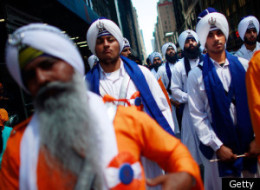
By Richard Yeakley Religion News Service
The Justice Department has filed suit against California prison officials on behalf of a Sikh inmate who says his religious freedom was violated when officials punished him for not cutting his beard. Sukhjinder Basra, incarcerated at the California Men's Colony in San Luis Obispo on a drug offense, was punished for refusing to shave his beard in accordance with prison grooming policy. The suit states that by requiring Basra to shave, the prison compelled him to rebel against his religious beliefs, a violation of the Religious Land Use and Institutionalized Persons Act. "The freedom to practice one's faith in peace is among our most cherished rights," said Thomas Perez, assistant attorney general for the Civil Rights Division. "RLUIPA has proven to be a powerful tool in combating religious discrimination and ensuring religious freedom." RLUIPA became law in 2000 and defends the religious freedom of those in prisons, mental health facilities and state-run nursing homes. Practitioners of Sikhism hold that cutting one's hair violates God's design.

Haris’ movement suspected Hishammuddin of using the Alkitab issue for political mileage. — file pic
The Malaysian Civil Liberties Movement (MCLM) today urged Datuk Seri Hishammuddin Hussein to step down as home minister following his ministry’s move in stamping 5,100 copies of the Alkitab with its seal.
“His action and remarks smack of disrespect and arrogance not just towards the 10 per cent of the population who are Christians but also to those of other religions as the whole episode shows that the Malaysian government is repressive and discriminatory in its actions.
“Any person who respects the Holy Scriptures of any religion would be appalled by this,” said MCLM president Haris Ibrahim in a statement today.
Yesterday, Hishammuddin has defended his ministry’s stamping of the 5,100 Malay-language bibles in Port Klang with its official seal, saying it was standard protocol and not done to “deface” the Alkitab.
The minister also said his men had no choice but to adhere to these procedures as the importers, the Bible Society of Malaysia (BSM), had wanted the Bibles to be released quickly.
“We stamped the Bible based on amalan (practice) before... during Abdullah Badawi and even Tun Dr Mahathir’s time,” Hishammuddin told reporters today, referring to the two immediate past prime ministers.
Hishammuddin then appeared to suggest that the Christian community’s uproar over what they considered a violation of their holy book was manufactured.
“They wanted it to be released quickly... if they want to find fault they can find fault... you can even say the Bibles are smelly after being kept for so long, if you want to find fault (with everything),” the minister claimed.
Today, Haris said the MCLM was concerned the Home Ministry’s stamping of the bibles was an election ploy to gain votes among Malay/Muslims ahead of the Sarawak state elections.
“If this is the case, then MCLM would like Hishammuddin to also apologise for using a religious matter for political gain.”
“We reject any attempt to restrict the freedom of religion in our country,” added Haris, a lawyer by profession.
He also demanded that the government withdraw the conditions imposed on the release of the Bibles impounded in Port Klang and Kuching.
The 35,100 Alkitab bibles are presently still held by the home ministry in the two ports as Christian leaders have refused to collect them due to the conditions imposed on their release.
The ministry had set two conditions to the importers of the consignments to allow the release of the books — that each book is stamped with a serial number and a ministry disclaimer that says “For Christians Only”.
The government’s more to release of the bibles have, however, sparked fresh concerns of reigniting Malay-Muslim anger and fears over non-Muslim use of the word “Allah”, which reached a critical point last year with arson and vandal attacks on several houses of worship.
The Christian and Muslim religious communities have been engaged in a tug of war over the word “Allah”, with the latter group arguing that its use should be exclusive to them on the grounds as Islam is monotheistic and the word “Allah” denotes the Muslim God.
Christians, however, have argued that “Allah” is an Arabic word that has been used by those of other religious beliefs, including the Jews, in reference to God in many other parts of the world, notably in Arab nations and Indonesia.
The tussle is still trapped in the courts after the ministry won a stay of the 2009 High Court ruling that allowed Catholic weekly The Herald to use “Allah” in its Bahasa Malaysia edition.
I love it when people say things like this to me: "I've been afraid my whole life, and I didn't know it ... I'm tired of being afraid ... I don't think God wants me to be afraid ... and I'm not going to let fear rule my life." Having been a priest for nearly 20 years, I've learned to appreciate the profoundly religious significance of their meaning. A few weeks ago, I heard it again on the radio. An interviewer put this question to a young woman on the streets of Cairo, "Aren't you afraid?" "No," she quickly said, "I'm not afraid ... I'm not afraid anymore." The Spirit of God can be expressed in many ways, and that's definitely one of them. That's how the process of liberating, transformative change begins. The world changes because the relationship we have to our fear changes.
There are many different kinds of fear, and some fear is obviously good. The fear that alerts us to real danger, focusing our energy and attention when we need it, can save our lives. But most of our fear is not like that. Most of it is unacknowledged, manufactured, manipulative -- and harmful. Its source lies in social, economic and political forces that seem more powerful than we are, despite the fact that their existence depends almost entirely on the power -- the fear -- that we give to them. Harmful fear divides communities. It undermines our health, spiritual sensitivity, our capacity to make sound moral judgments and our faith. Rather than being a lifesaver, most of our fear makes us our own worst enemy -- and a very real threat to others. It's not easy to perceive the extent to which our public life has become ruled by fear. At times like this, we need religion to help us discern the difference between reality and illusion, so we can move through our fear. Sadly, tragically, some churches may be an obstacle (they may reinforce our fear) rather than a help to people in need. For example, I know and believe that "the fear of the Lord is the beginning of wisdom" (Psalm 111:10a), but it's easy to respond to the "fear" word, rather than the sense of humble awe that this famous biblical passage is meant to instill. I know too that "there is no fear in love, but perfect love casts out fear" (1 John 4:18a), but it's easy to forget that when my thoughts are imprisoned by fear and my heart is closed to one of the genuine purposes of spiritual traditions: to free us from the fear that tries to rule our lives. Fear has set down some deep roots in our public and private lives, but it doesn't have to be this way. With the support of God and faith, which are not separate from courage, we can find it within ourselves to reach down and pull out the poison. We can do this by cultivating the spiritual instincts that we've all been given. I'm thinking of awe, love, intent, conscience, community, rest and faith. If we fail to cultivate these instincts within ourselves, then the primal fear response will take us down a road that seems safe and secure, but turns out to be a dead end. It could quite literally be a dead end for a lot of people, both our friends and neighbors, and many more that we've never actually met who are made in God's image just as much as everyone else. Let me make three easy suggestions: First, let's take a major hint from the practice of yoga. Let's learn to breathe easily again, as a form of prayer and prayerful living. This will cultivate loving-kindness in our bodies and souls as a way of life. We need that right now.
Second, let's go outside and experience the awe of a power greater than we are in God's green earth.
Third, let's cultivate a real sense of community and conscience again, remembering that no one person, or one people, is the very center of things.
If we think that these practices are have nothing to offer -- in effect, that fear has more power than us, or the Spirit within us, or the Spirit in God's creation -- then we need to think again about the world and what it means to be a person. We can learn to see what the fear within us is really like: disguised, as it usually is, as self-righteous anger, prejudice and the belief that I or we know better than everyone else. Once that happens, fear loses its power over our souls, and we can love again, and find the answers that we need in this turbulent time.
The Bible is a peculiar book, and it's hard to get straight information about it. If you're one of those people with a nagging feeling that you should know more about the Bible than you do -- or even if you can recite chapter and verse (but don't know that those chapters and verses come from a 13th century archbishop of Canterbury and a 16th century Parisian, respectively) -- then these five basic things will catapult you to a new level of biblical literacy. Though I might be handing you clunky corrective eyewear instead of sexy kitten glasses, I promise that they will change the way you look at the Good Book, clarifying and focusing your understanding. 1. Every Bible is actually a collection of books. The word itself means something like "little library." Many of the Bible's books developed over a long period of time and include the input of a lot of people (ancient Israelites, Babylonian Jews and Greek pastors, to name a few), reflecting particular places (urban Jerusalem, the northern Galilee, rural Judah and ancient Persia, for example) and times (spanning as much as 1,000 years for the Old Testament and a couple of centuries for the New Testament). Plus, the collection as a whole developed over centuries. This helps to explain the tremendous variety of theological perspectives, literary style, and sometimes perplexing preoccupations (which animal parts go to which parties in which categories of sacrifices, e.g.), as well as why some texts disagree with others. 2. Not everyone who believes in it has the same Bible. There are actually different bibles, though they all started with Jews (but before Judaism, per se). The Christian bible includes and depends upon the Jewish bible -- the Protestant Christian Old Testament is composed of the same books as the Jewish Hebrew Bible, arranged in a different order; and non-Protestant Christians include a few more books and parts of books (which also originated in Jewish circles) in their Old Testaments. The books of the Christian New Testament reflect the process of Jesus' followers gradually distinguishing themselves from his religion, Judaism. 3. The Bible came after the literature it comprises. In other words, the material that became biblical wasn't written in order to be part of a Bible. This helps to explain the existence of a book of erotic love poetry (Song of Songs), one that doesn't mention God (Esther), another of intimate personal correspondence (Paul's letter to Philemon) and maybe why none of it was written by Jesus. The biblical texts are not disinterested reporting of objective facts but come from people of faith informed by particular beliefs. 4. If you're reading the Bible in English, you're reading a translation. With the exception of a small minority of Aramaic texts, the books of the Old Testament or Hebrew Bible were all written in Hebrew. The books of the New Testament were written in Greek. Every translation is by nature interpretation. If you've ever studied a foreign language, you know that it's impossible to convert exactly and for all time the literature or speech of any given language into another. A translator has to make choices. There are often several ways to render the original text, and changes in English affect the meaning we read as well. 5. Finally, this information about the Bible is compatible with belief in it. A person can simultaneously accept these truths about the Bible and the Bible as the Word of God. Doing so may require recalibrating assumptions, though, to allow for the possibility that God patiently works through people and time, enjoys a good debate and prefers inviting conversation over issuing absolutes. (Even the Ten Commandments, which would seem to be as absolute as anything, show up in two places in the Bible -- and with some differences.) The Bible's endurance is astonishing. It continues to instruct and to inspire (in all sorts of interpretations and ways) the millions of people for whom it is their sacred and authoritative text. And it continues to ignite the imagination and enrich the speech, literature and art of people outside of the biblical faiths, too. Knowing the few bits of information provided here, as plain and pedantic as they may seem, makes it possible to make sense of the Bible -- its uses and abuses -- for yourself. It's like having the kind of friend who you know will keep you straight, surprise and delight you and encourage you to keep becoming exactly you. This information is more than a starting point. It's also a companion along the way, enabling new insights, providing correctives, and allowing space for the dynamism of your own ideas and learning.
Kristin Swenson is the author of Bible Babel: Making Sense of the Most Talked About Book of All Time (Harper, 2010; Harper Perennial, 2011) now available in paperback! She is an Associate Professor of Religious Studies at Virginia Commonwealth University.
Comments
2,817
Pending Comm
