
THE MAT ZAIN LETTER
Shafee Yahya and the Mahathir
abuse of power investigation
in the Ali Abul Hassan case
Shafee Yahya and the Mahathir
abuse of power investigation
in the Ali Abul Hassan case
uppercaise
In an implied challenge to the anti-corruption director who accused Dr Mahathir Mohamad 10 years ago of abuse of power and obstructing the cause of justice, the chief police investigator in the case has suggested that a new police report be made against Dr Mahathir so that investigations may be resumed.
In a sensational open letter published at Malaysia Today, retired Deputy Commissioner of Police Mat Zain Ismail made the suggestion in the light of what he termed as a massive perversion of the criminal justice system from the activities of Musa Hassan, newly-retired Inspector-General of Police, and Gani Patail, the Attorney-General, over the past decade.
Mat Zain asserted that Musa Hassan and Gani Patail had falsified evidence in several cases involving Anwar Ibrahim, and he accused them of being the cause of thedestruction of the criminal justice system.
Because of their actions, Chapter XI of the Penal Code, in effect, no longer existed, Mat Zain said. Chapter XI relates to giving false evidence and of offences against public justice.
 The full text of the Penal Code [PDF file 450KB] is available at the Attorney-General’s Chambers website
He said he had written a lengthy report to the current IGP, Ismail Omar, in May this year warning him of possible interference and false evidence being brought against Anwar again in his current “Sodomy II” trial on new sodomy charges. He was hopeful that Ismail would take some action.
In view of these developments, he suggested that Shafee Yahaya, head of the Anti-Corruption Agency in 1998, make a fresh police report so that the Mahathir abuse of power investigation could be reopened.
Mat Zain, as head of Kuala Lumpur CID then, had handled the Mahathir investigation, and later recommended that the investigation be halted for lack of sufficient evidence.
The Mahathir investigation was started after Shafee testified at a High Court hearing in June 2000 that Mahathir had ordered him to stop corruption investigations into Ali Abul Hassan, the director-general of the Economic Planning Unit at the Prime Minister’s Department, in whose office drawer ACA officers had found RM100,000 in cash in 1998.
The next day Anwar Ibrahim had made a police report against Dr Mahathir, followed by 14 other reports over the following month.
In his open letter of 8 October to Shafee’s wife and biographer, Mat Zain gave a detailed account of his investigation and the reason for his recommendation that it be halted.
He said it was because Shafee had failed to make any written notation in any of the files or papers in the Ali Abul Hassan case regarding Dr Mahathir’s instructions. Although Shafee had also spoken to the Chief Secretary on this, and evidence could be obtained from other witnesses, these would amount to hearsay as Shafee and Mahathir were the only ones privy to what transpired at their meeting.
Mat Zain said he himself was dissatisfied with Shafee’s responses when interviewed by a CID officer at his home. Shafee himself stated that NO DIRECT INSTRUCTION was given by Mahathir to shut down or stop the investigation of the case.
“
However Dato Shafee also said that Tun Mahathir’s behaviour and criticisms at every meeting, when taken as a whole, clearly meant that Tun Mahathir wanted him (Dato Shafee) to end the investigation into Tan Sri Ali Abul. Dato Shafee confirmed that his meetings with Tun Mahathir were “on a one to one basis.” Thus there is no independent witnesses to verify what actually transpired between them. Proof of Dato Shafee’s claim will depend on the extent to which Dato Shafee himself had kept a record, in a diary or a file related to the investigation.
Mat Zain said he had closely gone through two ACA investigation papers on the Ali Abul Hassan case to see whether Shafee had made any notation or order that the investigation should be closed on the instruction of Dr Mahathir.
“I needed such proof before I could seek an interview with Tun Mahathir and record his responses to questioning face-to-face, as I did before in the ‘black eye’ case. Tun Mahathir is no ordinary man, as well as being the sitting prime minister. This does not mean that police were afraid to record his statement,” Mat Zain said.
He said he had no fears when he personally interviewed Mahathir in the “black eye” case because he was armed with all the facts of the case — although certain “creatures” had tried to influence Mahathir to believe that Anwar Ibrahim’s injuries were self-inflicted — and was able to state that this was not true.
“
More importantly I recorded in my investigation diary every detail of what transpired at the meeting. What I said to Tun Mahathir and what he said and his advice to me, everything I recorded. Even when Tun Mahathir merely nodded approval, I recorded in my diary, which remains part of the investigation papers to this day.
Mat Zain regretted that Shafee had made no such notations in the investigation papers regarding Mahathir’s implied instructions.
“That was what I hoped to find when I examined the ACA’s investigation papers.”
Mat Zain also regretted that Shafee had not taken further measures during the three months before his retirement in September 1998, although he was the sole witness to the meeting with Mahathir.
Should Shafee wish to press on with the abuse of power accusation against Dr Mahathir, he could make a fresh police report, Mat Zain said, as there was no statute of limitation on criminal cases.
However, he said Shafee must be prepared to recount every detail of his testimony and of the statement recorded by the police. As Shafee himself did not have a copy of that statement, Mat Zain warned that any material discrepancies might lead to Shafee being held to account for giving false evidence
Opposition Leader Anwar Ibrahim was never given a chance to defend himself, contrary to what former premier Mahathir Mohamad wrote in his memoir.
“I followed Anwar to the 38th floor of Putra World Trade Centre for the Umno supreme council meet. He was never given a chance to answer the charges. Mahathir began the meeting by saying that he wanted Anwar sacked from the party,” Machang MP Saifuddin Nasution told a press conference on Thursday.
Both Anwar and Saifuddin were Umno leaders at that time. Anwar was both Deputy Prime Minister and Finance Minister, but he fell from grace after allegedly refusing to bail out one of Mahathir’s sons from the Asian financial crisis.
Pundits who have followed the 1998 incident have also accused Mahathir of jealousy towards Anwar, who was proving to be more popular than him within their Umno party.
Hence, the trumped-up sodomy charges which were overthrown in 2004, just months after Mahathir finally stepped down. Even so, Anwar had to spend 6 years in jail although the sodomy ‘victim’ had already testified that he had not been sodomized at all and had been coerced into making the false accusations.
It was then that the Malaysian judiciary finally lost its reputation for integrity. The court assembled by Mahathir was condemned worldwide and labelled a kangaroo trial because the judge refused to accept or consider any evidence that favoured Anwar.
A legacy of spite and hate
On Thursday, Saifuddin recounted how Mahathir had brushed aside any opposition from the other Umno supreme council members. In the end, his iron will won and none of them dared to oppose him.
“In his book, Mahathir also said that former IGP Hanif Omar had warned him of Anwar's wrongdoings as far back as in the early 1990s,” said Saifuddin.
“But everyone who is slated for a high government post must go through a personality clearance, administered by Bukit Aman. If Hanif had evidence against Anwar then, how could Anwar have managed to be a minister, the education minister and then the deputy prime minister?”
Mahathir launched his book “A Doctor in the House” earlier this week. He had harsh words for all of his ‘enemies’ including Singapore’s minister mentor Lee Kuan Yew, whom he accused of wanting to become Prime Minister of Malaysia.
Though the opening session was quickly suspended over a technical legal issue, former President Jacques Chirac's much-ballyhooed corruption trial began today in Paris, decades after he allegedly used Paris city coffers to fund illegal jobs that benefited his conservative party.
As the Associated Press is reporting, the trial focuses on Chirac's time as Paris mayor between 1977 and 1995 - before he was elected president - and accusations that he and his allies misused city funds.
Still, as the Telegraph notes, Chirac has deftly succeeded in avoiding a host of corruption probes - most linked to illegal party funding - thanks to his presidential immunity.
Take a look at his previous scandals here:
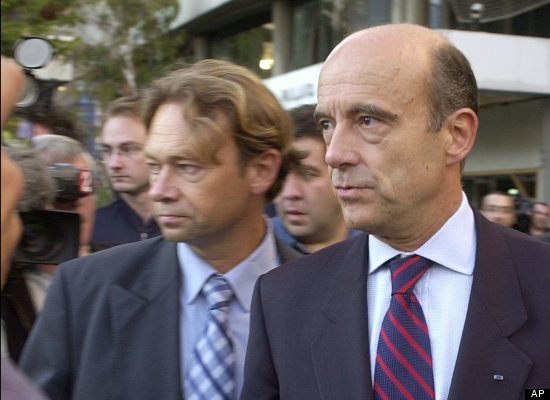
The graft case was launched in December 2002 and focused on the fraudulent payment of members of Chirac's conservative Rally for the Republic (RPR) party by the City of Paris. Chirac's right-hand man during much of that time was Alain Juppe (right) a former prime minister whose career was derailed by the scandal. Juppe was given a 14-month suspended jail term in December 2004 and barred from public office for one year, but is now Foreign Minister.
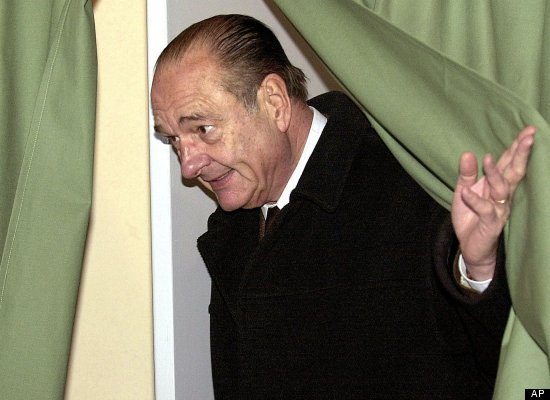
Paris School Building Contracts Scam
The Telegraph reports that in 2005, dozens of Chirac's close aides received suspended prison terms over a £50 million kickback scam from £2.5 billion in Parisian school building contracts, which they illegally funneled into the RPR, the party Chirac founded in 1976.
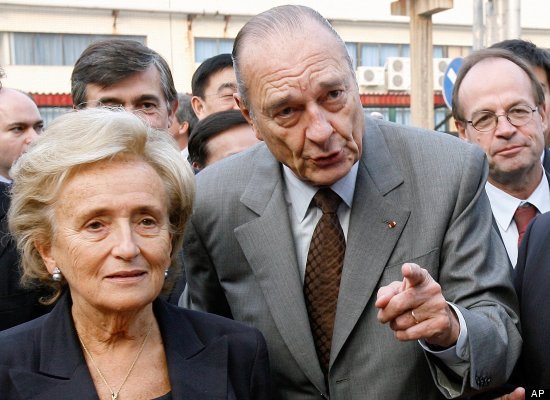
Travel Expenses Claims
Investigators established in 2001 that Chirac had paid the equivalent of about £330,000 in cash for dozens of luxury family holidays between 1992 and 1995, and suspected it came from kickbacks, theTelegraph is reporting. Though Chirac (shown here with wife Bernadette) claimed it had been financed from presidential bonuses, the source of this money has never been established.
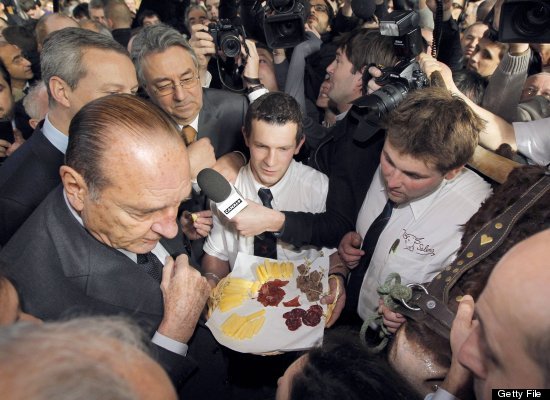
Frais De Bouche (food expenses) scandal
In 2002, Paris city officials filed a civil complaint about millions of euros allegedly spent on lavish dining -- including foie gras and truffles, much of it paid for in cash -- by Chirac when he was mayor of Paris. Charges were later dropped, the Independentreported.
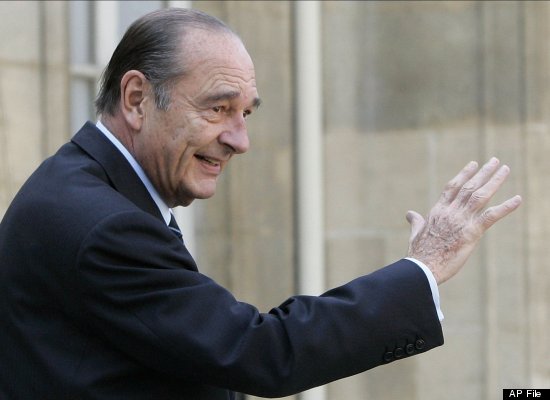
Japanese Bank Account
As the Guardian reports, Chirac came under renewed pressure in 2007 to respond to allegations that he held a secret £30m account with a Japanese bank, amid reports that documents had emerged linking the former French president to the funds. Though Japanese authorities said they had found no record of any such account, judges are said to have quizzed a retired senior intelligence officer for nine hours over documents, described as "explosive," linking Chirac to the account
.
Vote-Rigging In Paris
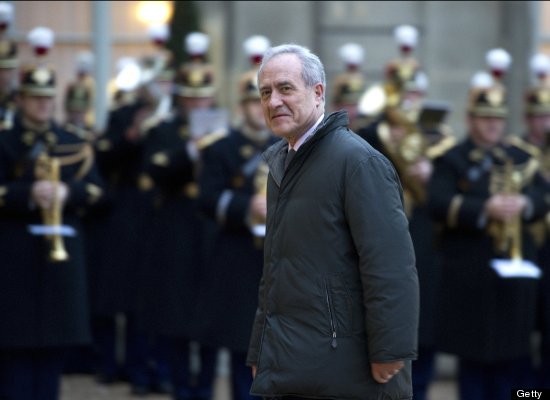
In the 3rd and 5th arrondissements of Paris during Chirac's time as mayor and under his successor, Jean Tiberi (pictured), people were allegedly illegally registered on electoral lists, sometimes at the address of a hotel or of a shop, in an attempt to modify the outcome of municipal elections. As the Telegraph reports, Tiberi received a 10-month suspended sentence and three-year ban from holding elected office over the scam.

No comments:
Post a Comment