SAVE MALAYSIA’S JUDICIARY, SAVE ITS MIND REVOLUTION

The appearance of Hosni Mubarak in the opening of his trial reassured millions of Egyptians that their revolutionary struggle was not in vain. But, as Egypt and the world watch the resumption of proceedings today, the truth about Mubarak’s ability to participate in his trial is still unclear. It is unusual for a defendant to appear in court on a stretcher – a defendant’s health is either good enough for him to stand trial or not. With the public doubting the court’s seriousness, Mubarak’s appearance could have been a political decision aimed at boosting confidence. If this is the case, the judiciary risks appearing politicised in the eyes of Egyptians.
Domestic trials to address crimes of past regimes in transitional societies almost always face major challenges, especially when political transformation is still underway and the vetting of state institutions is not complete, as is the case in Egypt. The desire to seek justice early is understandable, given the gravity of alleged crimes – yet the rush to get trials underway could bring undesired results.
Judiciary challenges
Human rights organisations, lawyers, judges, and families of victims have expressed doubts about investigations carried out by the general prosecutor since Mubarak’s downfall. This can be attributed to a number of factors, not least that Mubarak himself appointed the prosecutor overseeing inquiries before leaving power. Under Mubarak’s rule, the prosecutor’s office was regularly criticised for being used as a tool to silence opposition. According to human rights activists, the office was complicit with the policy of impunity.
Investigations are also affected by the continued abuse of power by the police, which still has not undergone a serious vetting process, despite the interior minister’s measures aimed at changing its image. Human rights organisations have discovered numerous cases of witnesses and relatives of victims being pressured by police officers accused of killing protesters to change their statements, or to prevent them from filing complaints.
Egyptian society suffers from a growing discourse of political vengeance and popular pressure on judges to expedite trials. The public demand to accelerate judicial procedures is understandable given the gravity of violations, the lack of transparency in prosecution strategy, and the hurdles to victim participation. But the demand to expedite trials does not take into consideration guarantees granted to the defence, nor to the complicated nature of investigating this magnitude of political and economic crime. It is hard to imagine a thorough professional investigation into such grave abuses in these circumstances.
Nonetheless, the judiciary must be able to work calmly to ensure a sound process, and to accomplish justice that is not vengeful. Justice and the rule of law were at the heart of the Egyptian revolution. If Egyptians want to break with the past they must encourage a fair judicial process. Furthermore, these trials will constitute a historical documentation of the transition period. Thus, a fair and careful process is in the interest of present and future generations.
The Egyptian judiciary is not accustomed to communicating with the public and the media. The attempts at providing details and procedures therefore feed speculation and rumours about inquiries and trials. Despite the importance of some steps recently taken by the Supreme Judicial Council to make trials public and ensure victim participation, other outreach measures are still needed to mend the bridge of confidence with the public.
The absence of strategy
Mubarak’s trial cannot be seen as part of a comprehensive strategic framework to address violations of the past regime. Most reformative steps taken by the transitional government have been in reaction to public pressure, rather than based on a clear strategy that would attend to the various challenges of the transition.
Inquiries and charges for human rights abuses pressed against members of the former regime thus far have not gone beyond crimes that occurred during the 18 days of the Egyptian revolution. There has been no effort to draw a picture of Egypt’s decades of repression and the rights of those victimised by it.
Local and international human rights organisations and UN human rights bodies have been documenting human rights violations in Egypt, including in the framework of combating terrorism, such as torture, extrajudicial killing, long-term arbitrary detention, and forced disappearance. So far there seems to be no political will to investigate these crimes and hold perpetrators accountable – despite calls from civil society to address these violations.
Achieving justice and accountability has contributed to bringing together other societies torn by conflict and authoritarianism. It is not a panacea to all of a society’s problems, but it can help society express its past grievances and re-establish trust in state institutions – two necessary steps in walking to a more open society. The political moment in Egypt can be built upon to strengthen the rule of law and human rights. Trials of the symbols of the former regime, with Mubarak at their head, might give impetus in that direction. Nevertheless, if the challenges threatening the integrity of these trials are not addressed, the course of criminal trials may seriously undermine the transition, as well as the people’s confidence in the judiciary.
Lawyer Rosli Dahlan will now discover that the new MAS management is about to abandon and dump him at the instructions of Nazri Aziz. Nazri even had the audacity to direct that all the other lawyers presently representing the respective GLCs be dropped and to be replaced by his and UMNO’s preferred lawyer Dato’ Hasfarizam.
Judiciary challenges
Human rights organisations, lawyers, judges, and families of victims have expressed doubts about investigations carried out by the general prosecutor since Mubarak’s downfall. This can be attributed to a number of factors, not least that Mubarak himself appointed the prosecutor overseeing inquiries before leaving power. Under Mubarak’s rule, the prosecutor’s office was regularly criticised for being used as a tool to silence opposition. According to human rights activists, the office was complicit with the policy of impunity.
Investigations are also affected by the continued abuse of power by the police, which still has not undergone a serious vetting process, despite the interior minister’s measures aimed at changing its image. Human rights organisations have discovered numerous cases of witnesses and relatives of victims being pressured by police officers accused of killing protesters to change their statements, or to prevent them from filing complaints.
Egyptian society suffers from a growing discourse of political vengeance and popular pressure on judges to expedite trials. The public demand to accelerate judicial procedures is understandable given the gravity of violations, the lack of transparency in prosecution strategy, and the hurdles to victim participation. But the demand to expedite trials does not take into consideration guarantees granted to the defence, nor to the complicated nature of investigating this magnitude of political and economic crime. It is hard to imagine a thorough professional investigation into such grave abuses in these circumstances.
Nonetheless, the judiciary must be able to work calmly to ensure a sound process, and to accomplish justice that is not vengeful. Justice and the rule of law were at the heart of the Egyptian revolution. If Egyptians want to break with the past they must encourage a fair judicial process. Furthermore, these trials will constitute a historical documentation of the transition period. Thus, a fair and careful process is in the interest of present and future generations.
The Egyptian judiciary is not accustomed to communicating with the public and the media. The attempts at providing details and procedures therefore feed speculation and rumours about inquiries and trials. Despite the importance of some steps recently taken by the Supreme Judicial Council to make trials public and ensure victim participation, other outreach measures are still needed to mend the bridge of confidence with the public.
The absence of strategy
Mubarak’s trial cannot be seen as part of a comprehensive strategic framework to address violations of the past regime. Most reformative steps taken by the transitional government have been in reaction to public pressure, rather than based on a clear strategy that would attend to the various challenges of the transition.
Inquiries and charges for human rights abuses pressed against members of the former regime thus far have not gone beyond crimes that occurred during the 18 days of the Egyptian revolution. There has been no effort to draw a picture of Egypt’s decades of repression and the rights of those victimised by it.
Local and international human rights organisations and UN human rights bodies have been documenting human rights violations in Egypt, including in the framework of combating terrorism, such as torture, extrajudicial killing, long-term arbitrary detention, and forced disappearance. So far there seems to be no political will to investigate these crimes and hold perpetrators accountable – despite calls from civil society to address these violations.
Achieving justice and accountability has contributed to bringing together other societies torn by conflict and authoritarianism. It is not a panacea to all of a society’s problems, but it can help society express its past grievances and re-establish trust in state institutions – two necessary steps in walking to a more open society. The political moment in Egypt can be built upon to strengthen the rule of law and human rights. Trials of the symbols of the former regime, with Mubarak at their head, might give impetus in that direction. Nevertheless, if the challenges threatening the integrity of these trials are not addressed, the course of criminal trials may seriously undermine the transition, as well as the people’s confidence in the judiciary.
Lawyer Rosli Dahlan will now discover that the new MAS management is about to abandon and dump him at the instructions of Nazri Aziz. Nazri even had the audacity to direct that all the other lawyers presently representing the respective GLCs be dropped and to be replaced by his and UMNO’s preferred lawyer Dato’ Hasfarizam.
Nazri’s directive is a blatant display of raw power. Nazri must have forgotten that these GLCs have public shareholders and they are not just some jabatan kerajaan (government department) that Nazri can give orders to. This is a classic case of abuse of power by a public officer which MACC should immediately investigate.
I am happy that public outrage has now forced Nazri to back pedal into saying that he merely gave “advice” and did not give any “directions” to the GLCs. Unfortunately for Nazri, Malaysia Today had posted his August 8 letter which plainly shows Nazri had lied in his public statements.
Abu Hurayrah quoted that the Prophet said:
“The signs of the hypocrite are three: when he speaks, he lies; when he makes a promise, he breaks it; and when he is entrusted with something, he betrays that trust.” (Narrated by al-Bukhari, 33; Muslim, 59).
 I intended to also write that Nazri’s action amounts to an offence. But since my friend, Tan Sri Robert Phang, had already issued a press statement which says almost what I had intended to say, I will just reproduce Robert Phang’s statement (below).
For my enigmatic friend Nazri’s sake, I hope he will just admit his mistake, and not perpetuate any more lies. I know he will get angry reading this and he would probably challenge me in his usual “Anak Jantan” (fighting cock) style. But the truth has to be said, and the truth may at times be painful.
Since this is Ramadan, I would like to remind Nazri what the Quran says about liars in Surah 96: Al Alaq. God says “Lies, aggression and hostility come from the prefrontal lobe of the brain (behind the forehead)” and God will deal with the liars, the lying sinful liars in the following manner:
“Allah will grab him by the (naseyah) [frontal lobe of the brain], the lying sinful (naseyah).”
Yes, justice may be delayed, but it can never be denied. As I have always said, in Malaysia, 90% of rumours are always finally proven as fact in the end. And that is why Malaysians believe in rumours.–Raja Petra Kamaruddin, Malaysia-Today
“At all material times, I was acting as a nominee and agent of the Government and in the performance of a public duty and I was bound to act under the instructions and directions from the government.”–Tajuddin Ramli
THE MALAYSIA AIRLINES (MAS) STORY: OF PLUNDER, ABUSES AND LIES
by Din Merican
Yes, justice may be delayed, but it can never be denied. As I have always said, in Malaysia, 90% of rumours are always finally proven as fact in the end. And that is why Malaysians believe in rumours.–Raja Petra Kamaruddin, Malaysia-Today
“At all material times, I was acting as a nominee and agent of the Government and in the performance of a public duty and I was bound to act under the instructions and directions from the government.”–Tajuddin Ramli
 While the mainstream media and public relations firms spin yarns about the economic, financial and operational benefits of the MAS-AirAsia share swap deal, let me state up front that I am sceptical.
It is clear to me that the plunder of MAS 10 years ago when Tajuddin Ramlicontrolled 29% of its shares is about to repeat itself with the entry of Tony Fernandes as MAS’s new 20% shareholder. And Tony Fernandes did not even have to pay for these shares. All he did was to swap shares with Khazanah. For every 2 shares in MAS, Tony gave Khazanah only 1 share in AirAsia.
That AirAsia will gain from having Khazanah as a shareholder is clear. They will now have “government” muscle to achieve what they could not before. But let me leave that to the financial analysts to comment and write about.
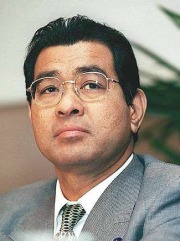 “government” muscle to achieve what they could not before. But let me leave that to the financial analysts to comment and write about.
The so-called “Global Settlement” or Bailout?
I have previously written about the “Global Settlement” that the government-linked companies (GLCs) are forced to enter with former Malaysia Airlines Chairman, Tajuddin Ramli. This Malay tycoon plundered the national carrier to the bones. Yet, to this day he lives in absolute luxury in his ranch at Kuang, which he pretentiously calls Ar-Raudhah or the Garden of Paradise.
That Tajuddin is immune from prosecution should not come as a surprise. This was already to be expected when Malaysia Today exposed that Tajuddin’s proxy, Shahidan Shafie, had gone to Haj as part of AG Gani Patail’s family. In case readers have forgotten,please see the official Tabung Haji document below:
 Shahidan’s name had also surfaced in court documents when the “Global Settlement” was first flouted in court. Read paragraph 4 of this document (below) that appeared in various blogs last year. At that time, I had already known that Shahidan is also close to Nazri Aziz and other UMNO leaders. This was convenient to allow Tajuddin to still cut deals without being seen.
The Persecution of Dato’ Ramli Yusuff
In the scheme of things, anyone who becomes a hindrance must be gotten rid off.That was what happened to the Director of Commercial Crimes PDRM, Police CommissionerDato’ Ramli Yusuff, after he recommended to then Prime Minister Abdullah Badawi that Tajuddin and gang be charged for various offences.
Instead, it was Dato’ Ramli who was stripped of his rank, suspended and charged and that ended the police investigations against Tajuddin. Until today, A-G Gani Patail is still pursuing various appeals against Dato’ Ramli who had been repeatedly acquitted by several Courts.
IOL Award for Litigation 2011 Winner: Lawyer Rosli Dahlan
The same thing happened when lawyer Rosli Dahlan, who won the IOL Award for Litigation 2011, continued to pursue MAS’s claim against Tajuddin for breaches of fiduciary duties which caused MAS to suffer losses running into billions of ringgit. Like Dato’ Ramli, Rosli was charged in court during Ramadan of 2007 to put the civil cases to an end. I have written extensively on Rosli’s trials and tribulations and will not repeat that story.
But even that did not put an end to the civil cases against Tajuddin. Now that the old MAS Board of Directors and Management have been be removed (or asked to resign, to put it more politely) with the MAS-Air Asia share swap deal, the timing is just right to also bail out Tajuddin and close the lid on this case.
Lawyer Rosli Dahlan will now discover that the new MAS management is about to abandon and dump him at the instructions of Nazri Aziz. Nazri even had the audacity to direct that all the other lawyers presently representing the respective GLCs be dropped and to be replaced by his and UMNO’s preferred lawyer Dato’ Hasfarizam.
Nazri’s directive is a blatant display of raw power. Nazri must have forgotten that these GLCs have public shareholders and they are not just some jabatan kerajaan (government department) that Nazri can give orders to. This is a classic case of abuse of power by a public officer which MACC should immediately investigate.
I am happy that public outrage has now forced Nazri to back pedal into saying that he merely gave “advice” and did not give any “directions” to the GLCs. Unfortunately for Nazri, Malaysia Today had posted his August 8 letter which plainly shows Nazri had lied in his public statements.
Abu Hurayrah quoted that the Prophet said:
“The signs of the hypocrite are three: when he speaks, he lies; when he makes a promise, he breaks it; and when he is entrusted with something, he betrays that trust.” (Narrated by al-Bukhari, 33; Muslim, 59).
I intended to also write that Nazri’s action amounts to an offence. But since my friend, Tan Sri Robert Phang, had already issued a press statement which says almost what I had intended to say, I will just reproduce Robert Phang’s statement (below).For my enigmatic friend Nazri’s sake, I hope he will just admit his mistake, and not perpetuate any more lies. I know he will get angry reading this and he would probably challenge me in his usual “Anak Jantan” (fighting cock) style. But the truth has to be said, and the truth may at times be painful.
Since this is Ramadan, I would like to remind Nazri what the Quran says about liars in Surah 96: Al Alaq. God says “Lies, aggression and hostility come from the prefrontal lobe of the brain (behind the forehead)” and God will deal with the liars, the lying sinful liars in the following manner:
“Allah will grab him by the (naseyah) [frontal lobe of the brain], the lying sinful (naseyah).”
To our government, I will just say this – stop the plunder, abuses and lies!
AUGUST 13, 2011
PRESS STATEMENT
 Tan Sri Datuk Robert Phang, Justice of Peace
CHAIRMAN – SOCIAL CARE FOUNDATION
NAZRI SHOULD STOP LYING AND THE GOVERNMENT STOP COVER UP
1. The public outrage over Dato’ Seri Nazri Aziz’s letter dated 8th August is justified. It is unprecedented and wrong for the Minister in the Prime Minister’s Office to direct all Government-Linked Companies (GLCs) to withdraw their civil suits against former MAS Chairman, Tan Sri Tajuddin Ramli. I find it very appalling that a Minister of Nazri’s seniority and status can direct GLCs to withdraw their claims against Tajuddin Ramli which means allowing him to get away with billions of ringgit in debt.
2. Nazri’s immediate back pedaling by attempting to say that his letter was only an “advice” and not a”directive” or “instruction” by itself shows that Nazri knew that he had made a grave error. Now that Malaysia Today has posted Nazri’s letter, it clearly shows that Nazri had lied. To make a mistake is one thing, but to lie in order to cover up for that mistake makes it worse.
3. Another aspect I find deplorable is the lethargy and disinterest shown by Attorney-General Gani Patail and the MACC in prosecuting Tajuddin Ramli. This contrasted sharply with the swift manner in which the MACC investigated me after I criticized A-G Gani Patail for his involvement and Haj Trip with a crony of Tajuddin, one Shahidan Shafie. Based on just a false allegation in an anonymous blog, I was subjected to an immediate investigation by the MACC.
4. I was also publicly humiliated when I was only conditionally cleared in a press statement issued on 31st May 2011 by the MACC Operations Evaluation Panel (OEP) Chairman, Tan Sri Dr. Hadenan Abdul Jalil. I have since demanded the MACC to give me an unconditional and unequivocal clearance. I have yet to receive the MACC’s reply.
5. If the MACC can be so speedy to act against me, why is the MACC showing hesitation to act against Tajuddin Ramli? There are overwhelming evidence against him available in the public domain including the report made by the former Director of Commercial Crimes, Dato’ Ramli Yusuff, to former PM Abdullah Badawi? All these smack of a cover-up.
6. Nazri’s action is also an abuse of power in asking for GLC legal work to be passed to a legal firm. Who are the lawyers of this legal firm that they should be given preference over other more eminent lawyers in the country? Are they Nazri’s associates and is he receiving gratification for this? If so, the MACC should investigate and prosecute Nazri under section 2(1) of the Emergency (Essential Powers) Ordinance No. 22/1970. Nazri should also be prosecuted under the MACC Act as follows:
MALAYSIAN ANTI-CORRUPTION COMMISSION ACT 2009
Offence of using office or position for gratification
Offence of using office or position for gratification
23. (1) Any officer of a public body who uses his office or position for any gratification, whether for himself, his relative or associate, commits an offence.
(2) For the purposes of subsection (1), an officer of a public body shall be presumed, until the contrary is proved, to use his office or position for any gratification, whether for himself, his relative or associate, when he makes any decision, or takes any action, in relation to any matter in which such officer, or any relative or associate of his, has an interest, whether directly or indirectly.
(3) For the avoidance of doubt, it is declared that, for the purposes of subsection (1), any member of the administration of a State shall be deemed to use his office or position for gratification when he acts contrary to subsection 2(8) of the Eighth Schedule to the Federal Constitution or the equivalent provision in the Constitution or Laws of the Constitution of that State.
7. I therefore call on the MACC to show some courage and investigate this matter. Otherwise, the MACC will forever not regain the public’s trust after Teoh Beng Hock and Ahmad Sarbaini had died over what the public perceived to be due to the harsh treatment by the MACC over much less serious allegations of corruption. Let its not be said that the laws of this country favor the strong over the weak.
8. Since this is the Muslim Holy month of Ramadan, I ask Nazri Aziz, who is always known to be courageous in a “jantan” way, to apologise to the Malaysian public for insulting our intelligence in this incident. Nazri needs to do so before he drags the whole administration of PM Najib Razak into public anger and odium. The government can least afford this sort of scandals with the elections being just around the corner.
“HUMBLENESS IS GOOD VIRTUE, ARROGANCE SHALL FALL, THE MEEK WILL RULE THE WORLD”.
The Egyptian judiciary is not accustomed to communicating with the public and the media. The attempts at providing details and procedures therefore feed speculation and rumours about inquiries and trials. Despite the importance of some steps recently taken by the Supreme Judicial Council to make trials public and ensure victim participation, other outreach measures are still needed to mend the bridge of confidence with the public.
The absence of strategy
Mubarak’s trial cannot be seen as part of a comprehensive strategic framework to address violations of the past regime. Most reformative steps taken by the transitional government have been in reaction to public pressure, rather than based on a clear strategy that would attend to the various challenges of the transition.
Inquiries and charges for human rights abuses pressed against members of the former regime thus far have not gone beyond crimes that occurred during the 18 days of the Egyptian revolution. There has been no effort to draw a picture of Egypt’s decades of repression and the rights of those victimised by it.
Local and international human rights organisations and UN human rights bodies have been documenting human rights violations in Egypt, including in the framework of combating terrorism, such as torture, extrajudicial killing, long-term arbitrary detention, and forced disappearance. So far there seems to be no political will to investigate these crimes and hold perpetrators accountable – despite calls from civil society to address these violations.
Achieving justice and accountability has contributed to bringing together other societies torn by conflict and authoritarianism. It is not a panacea to all of a society’s problems, but it can help society express its past grievances and re-establish trust in state institutions – two necessary steps in walking to a more open society. The political moment in Egypt can be built upon to strengthen the rule of law and human rights. Trials of the symbols of the former regime, with Mubarak at their head, might give impetus in that direction. Nevertheless, if the challenges threatening the integrity of these trials are not addressed, the course of criminal trials may seriously undermine the transition, as well as the people’s confidence in the judiciary.
READMORE

No comments:
Post a Comment