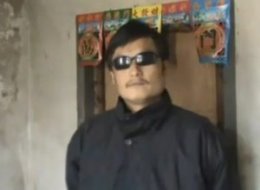
A high-profile, blind Chinese grassroots lawyer and his wife were severely beaten after secretly filming a video documenting their house arrest, the Guardian is reporting.(Scroll down for video)
In the amateur video, released online by a U.S.-based campaign group, Chen Guangcheng -- a self-taught legal advocate for women who had forced abortions and sterilizations -- and his wife Yuan Weijing describe the experience of being smuggled out of his family's village, and how the couple and their children were being held at home since Chen's release from prison five months ago. The video is hi "I've come out of a small jail and entered a bigger one," the 39-year-old Chen says in the clip, according to the BBC. Though their exact whereabouts are not unknown, the family is reportedly being monitored at all times, and devices have been placed in nearby homes to interfere with their cell phone signals.
The Telegraph cites Human Rights Defenders, an NGO, as saying that an "inside source" had confirmed to them that Chen and his wife had been beaten senseless in punishment after authorities learned of the video's existence. "They cannot move from bed, and they have not been allowed to go to hospital," said a statement.
Bob Fu of advocacy group ChinaAid, which has offices in Texas, made an impassioned plea for Chen's release. "Chen Guangcheng is a hero to many people around the world, a peaceful advocate for human rights and a defender of society's most vulnerable, its women and children," he said. The video is the first news of the Chinese advocate's whereabouts in five months.
Watch a segment of the secretly-shot video here:
The U.S. said Friday it would go ahead with a complaint against China at the World Trade Organization over restrictions on foreign payment-card firms like Visa Inc. andAmerican Express Co.
The U.S. also said it would challenge antidumping duties imposed on imports of U.S. steel in 2009, signaling that the Obama administration is intent on pursuing a muscular trade policy with China.
With the U.S. trade deficit with China growing—up to $252.4 billion in the first 11 months of 2010 compared to $208.7 billion for the same period in 2009 —the administration is under pressure to show it can defend key U.S. interests. It has also filed cases against China at the WTO over restrictions on exports of raw materials and subsidies.
U.S. trade officials say the Chinese payment-card business, worth hundreds of billions of dollars a year, is central to U.S. interests. They say they're keen to stop other emerging economies, whose booming middle classes are now providing the bulk of the sector's growth, from imposing similar curbs. The U.S. also wants to put more pressure on China to crack open its market for other kinds of services, such as law firms and consulting.
A Chinese company set up by the People's Bank of China, China UnionPay, has "a monopoly over the handling of domestic currency payment card transactions in China while excluding other potential suppliers," said U.S. Trade Representative Ron Kirk.
Only China UnionPay is allowed to handle credit-card payments in Chinese renminbi, and when Chinese travel overseas, their transactions in foreign currencies must also be handled by China UnionPay. The crux of the case concerns the business of intermediate payments between store and bank: Visitors can use foreign cards in China, but the card companies can have no piece of the lucrative business of processing transactions between the merchants and intermediary banks.
"Removal of the monopoly that China has provided to China UnionPay would create significantly expanded business opportunities in China's huge and growing market for American suppliers of this essential service," said Mr. Kirk.
One U.S. company, MasterCard Inc., last year dropped its involvement in the case and signed a cooperation agreement with China UnionPay. Still, MasterCard would also benefit should the WTO order a full opening of China's payment-card market. MasterCard declined comment.
The U.S. requested formal negotiations in China in September. China refused to discuss the restrictions. If, as expected, it accepts the case, the WTO will take 12 to 18 months to rule. It could then force China to get rid of the monopoly.
When it joined the WTO in 2001, China committed to opening big slices of its services market by 2006. "Opening up China's market, as China committed to do over four years ago, would create American jobs for the U.S. suppliers of electronic payment services," said Mr. Kirk.
Lingering restrictions on services, however, are a chief complaint for Western banks, law firms, consultants and other firms. The WTO's big Western service-dominated economies have tried for years without success to get emerging economies to guarantee access to service markets as part of the Doha Round of global trade talks. "There's no indication that China is opening its services sector in areas that matter to U.S. and EU economies like banking," said Jonathan Holslag, head of research of the Brussels Institute of Contemporary China Studies.
A spokesman for the Chinese mission to the EU said Beijing was committed to respecting its WTO obligations, but declined comment on the cases filed Friday.
In 2009, China imposed extra duties of up to 64.8% on imports from the U.S. of a "grain-oriented flat-rolled electrical steel", which is used to make machines for factories.
In its complaint, the U.S. charged that China "improperly used investigative procedures." WTO law allows an importer to levy duties on a product if it can prove it has been "dumped," or sold below cost, or unfairly subsidized by the exporting country.
"The U.S. likes to use antidumping and antisubsidy tariffs, so it is surprising that they would take another country to court for doing so," said Simon Lester, founder of WorldTrade Law.net LLC, a Washington-based consultancy. "It shows [Washington] is going on the offensive."
Write to John W. Miller at john.miller@dowjones.com

No comments:
Post a Comment