
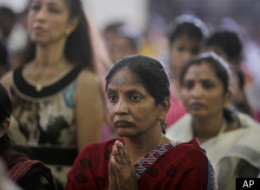
Catholics around the world are observing Ash Wednesday today, March 9, 2011.
If you too want to observe the holy day, there are a series of rules you should be familiar with.
First, you can not eat meat on Ash Wednesday, which marks 40 days before Easter and the beginning of Lent.
According to the Catholic law of abstinence, Catholics aged 14 and older must refrain from meat on Fridays altogether during this 40-day period, as well as Ash Wednesday.
Per the Code of Canon Law:
Canon 1251 Abstinence from eating meat or another food according to the prescriptions of the conference of bishops is to be observed on Fridays throughout the year unless they are solemnities; abstinence and fast are to be observed on Ash Wednesday and on the Friday of the Passion and Death of Our Lord Jesus Christ.
Also, it's time to put those paczkis away because Catholic adults are also mandated to faston Ash Wednesday. This is defined as consuming only one full meal or two smaller meals.
Many Catholics also get ashes on their forehead on Ash Wednesday, a reminder of our mortality (often stated as, 'we are dust and to dust we shall return'). Catholics are encouraged to attend Mass on Ash Wednesday, however, Ash Wednesday is not a holy day of obligation.
"If the lost word is lost, if the spent word is spent If the unheard, unspoken Word is unspoken, unheard; Still is the unspoken word, the Word unheard, The Word without a word, the Word within The world and for the world; And the light shone in darkness and Against the Word the unstilled world still whirled About the centre of the silent Word." --excerpt from T.S. Eliot's "Ash Wednesday"
Not all Christian churches observe Ash Wednesday or Lent. The Bible does not mention Ash Wednesday or the custom of Lent. Ash Wednesday, unknown in the Eastern Church, developed only in the West. But traditions of repentance and mourning in ashes date back at least to the time of 2 Samuel 13:19; Esther 4:1; Job 2:8; Daniel 9:3 in the Hebrew Bible; and Matthew 11:21 speaks about it.
Those of us who use Ash Wednesday to begin Lent find the 40-day season helpful in reconnecting us to the foundations of faith. We believe that Jesus began his public ministry at the age of 30 by being baptized and was immediately sent into a 40-day period of fasting and temptation. And the first Christians developed various devotional ways of remembering the days of Jesus' passion and resurrection. The Church created a variety of customs to prepare, many focused on the season of penitence and fasting. Ash Wednesday dates to at least the eighth century and appears in the Gregorian Sacramentary. Originally, Lent began on a Sunday, but to have the number of days of Lent correspond to the 40 days Jesus fasted in the wilderness, Lent was eventually transferred to begin on a Wednesday.
What evolved was a time when converts to the faith were prepared for Holy Baptism at the Easter Vigil, which begins in darkness and ends in light. That is the genesis of sunrise services. Poignantly, the Church saw Lent as a special time to acknowledge that those who had committed "notorious sins" and become "separated from the body of the faithful" could be reconciled by penitence and forgiveness.
Restoration to the fellowship of the Church was seen as a miracle -- a sign of God's power to re-create, renew and rebirth. As the Book of Common Prayer in my Episcopal tradition puts it, "...the whole congregation was put in mind of the message of pardon and absolution set forth in the Gospel of our Savior, and of the need which all Christians continually have to renew their repentance and faith."
The definition of the "observance of a holy Lent" is marked by disciplines of self-examination and repentance; by prayer, fasting and self-denial; and by reading and meditating on God's holy Word, all moving toward that purpose: to believe again in the power of God to offer us ways to "die to sin" and begin new life again. Harkening back to the garden of our first birth, there are two similar Hebrew words: adam -- the man, who was created from the ground, and adamah -- ground or dust, which emphasizes the fragility of humanity and the total dependence of the creature on the Creator.
On Ash Wednesday ashes are mixed with either holy oil or water and blessed and then put on persons' foreheads with the sign of the cross. Made from burning the palm branches from the previous Palm Sunday, those ashes are imposed as the priest says, "Remember that you are dust, and to dust you shall return" (referring to Genesis 3:19). Thereby we are reminded of our mortality and humanity and invited in humility to welcome the miracles God continues to reveal and empower us to participate in.
It is not sentimentalism that sustains our journey back to that first garden of paradise with intimacy and connection to God. Rather, it is our foundational and definitional need to be grounded -- remembering that we are dust, eternally connected to the source of all being. Even if we fail to open ourselves to that Word, God continues to speak and to act in the world. Listening opens us to be transformed and to become true stewards of all of creation.
Current events will offer us two directions to take Ash Wednesday this year, it seems to me. We can either feel more different and disconnected from the various peoples of the earth ravaged by violence, oppression, injustice and malfeasance. Or we can feel the ruptures as tearing away at the very fabric of humanity we share, knit together by God, who more than shares our pain by daring to become human in Jesus. The focus on the passion and death of Jesus, which culminates in the final phase of Lent -- Holy Week -- does not simply open the door to an Easter celebration. We believe that the Holy Cross redeems the world by lifting onto it all suffering, across time and cultures. That is our authentic shared humanity.

The Malay Bibles contain the word ‘Allah’. — File pic
Spurred by the Home Ministry’s latest seizure of 30,000 Malay Bibles that cost US$26,000 (RM78,000) from Kuching port, the churches rallied together and issued a stinging rebuke today against Prime Minister Datuk Seri Najib Razak.
They demanded he “prove their (the government) sincerity and integrity in dealing with the Malaysian Christian community on this and all other issues which we have been raising with them since the formation of the Christian Federation of Malaysia in 1985”.
“The Christian Federation of Malaysia (CFM) is greatly disillusioned, fed-up and angered by the repeated detention of Bibles written in our national language, Bahasa Malaysia.
“It is an affront to them that they are being deprived of their sacred scriptures. Many are wondering why their scriptures are considered a threat to national security. All these actions in relation to the detention of the Bibles continue to hurt the Malaysian Christian community,” it said in a statement today signed by its chairman, Bishop Ng Moon Hing.
They demanded the government immediately release all Bibles detained.
The CFM is the umbrella body that represents over 90 per cent of churches in the country.
Malaysian Christians make up close to 10 per cent of the 28 million population; with the biggest numbers based in Sarawak and Sabah, where the main language used by the Bumiputeras in churches is Bahasa Malaysia.
The CFM noted that the federal government has been thwarting all attempts to import Malay Bibles from outside Malaysia since March 2009, “despite repeated appeals which resulted in the prime minister making a decision to release the Alkitab held in Port Klang in December 2009 which was reported to CFM leaders by several Cabinet ministers and their aides.
“This is notwithstanding that the government in its attempt to justify its position against the use of the word ‘Allah’ in the Alkitab, the government had given the assurance that the Bible in Bahasa Malaysia will be freely available, at least in Sabah and Sarawak,” it said.
The Catholic Church had won a landmark judgment on December 31, 2009 that gives it the right to publish the word, but has effectively been barred from doing so pending the government’s appeal.
The group pointed to two separate shipments totalling 15,000 copies that had been seized by Home Ministry officials and left to languish for over a year at Kuching port and Port Klang in Selangor.
CFM said officials at Port Klang have steadfastly refused to release the 5,000 copies imported by the Bible Society of Malaysia (BSM).
“In absolute disregard of this decision, the 5,000 copies of the Alkitab remain detained,” CFM said.
It added that there were other shipments of Bibles and other Christian material before March 2009 that were confiscated by ministry officials that have yet to be returned to their owners.
One such case involves Sarawakian Christian Jill Ireland Lawrence Bill, whose personal collection of Christian CDs — bought on a trip to Indonesia — were seized by Malaysian Customs officials at the airport here in May 2008 allegedly for being a threat to national security.
Jill filed to sue the Home Ministry at the High Court here but her case has also been languishing in the courts.
Her lawyer, Annou Xavier, told reporters in Putrajaya that the case was fixed to be mentioned today, but no hearing date was given.
CFM questioned if the government was powerless to act against these “little Napoleons” who substitute their own interests and agenda in place of the prime minister’s directives”.
“We would ask how the government’s transformation programme can be successfully implemented if civil servants can blatantly refuse to obey the prime minister’s order?”
Ng told The Malaysian Insider today that he had personally raised the hold-up of the Bibles with the prime minister during a Christmas open house last year.
“He said he was surprised and told me ‘I need to go back and check but I’ll look into it’,” Ng said, relating his conversation with Najib.
He added that the PM was likely told that the Kuching shipment has been released without knowing anything about the Port Klang shipment.
The Malaysian Insider understands that the first consignment of 10,000 copies seized at Kuching port was released on Christmas last year after the prime minister stepped in.
Ng said the churches would continue to apply pressure on the Najib administration.
“We will not stop appealing. If we give up, it means the end of our religion,” the head of Malaysia’s Anglican church said.
By Omar Sacirbey Religion News Service
(RNS) When Los Angeles County Sheriff Leroy Baca asked Sgt. Muawiya "Mike" Abdeen to set up a liaison unit to local Muslims in 2008, the idea was to build bridges to a community that is often fearful of, or unknown to, law enforcement. It was tough going at first, said Abdeen, a 23-year veteran of the Sheriff's Department. "When we used to drive up to a mosque or a Muslim school, people would get scared, they walked away, they closed the doors," said Abdeen, 48. But the officers kept returning, helping with parking during Friday prayers, giving talks to Muslim youths about safe driving, and meeting with local and national Muslim groups. Now, Abdeen said, deputies are welcomed with hugs and tea. "I always tell other officers, 'If you expect the community to talk to you, you have to talk to them, too," said Abdeen, who was born in Jerusalem and came to the U.S. at age 20. "Terrorism is just a small part of it. The community wants to see that the local police department is genuinely interested in helping them solve the daily quality-of-life issues." As hearings on Capitol Hill raise the specter of "extremist" Muslims who don't cooperate in terror investigations, the thin blue line of Muslim cops and deputies offer a glimpse of American Muslims who put their lives -- and sometimes their faith -- on the line in the interests of security. Baca said he has no doubts about Muslims' loyalty to America after deputy traineee Mohamed Ahmed was shot and nearly killed by an alleged gang member earlier this year. "I've worked with Muslim deputies, and I know that Muslim deputies are as courageous as any other deputies," said Baca, who had recruited the Somali-born Ahmed as part of his effort to improve relations between law enforcement and local Muslims. It's not just Muslims who need to overcome fear and suspicion: Muslim officers often have to brief their comrades on Islamic beliefs and etiquette, which is why Abdeen recently worked with the Muslim Public Affairs Council to develop a 15-minute training video. In February, Capt. Paul Fields of the Tulsa, Okla., Police Department was disciplined for refusing to attend a "Law Enforcement Appreciation Day" at a local mosque. He quickly filed suit, alleging a violation of his religious rights because he said visiting a mosque to make nice with Muslims is not a police duty. The greater challenge, however, is forging positive relationships with local Muslims who are wary of undercover FBI agents inside their mosques, or dragnet prosecutions in the wake of 9/11. House Homeland Security Chairman Peter King, R-N.Y., who will convene the hearings on homegrown extremism, has charged that "the leadership of the (Muslim) community is not geared to cooperation." Baca, who is scheduled to testify at King's hearings, disputes those charges, saying Muslims have several times led officials to extremist individuals. When there is a lack of cooperation, it doesn't necessarily imply terrorist sympathies. "It's not that they don't want to cooperate, but because they either don't know that we are there for them, or often because they're scared to reach out to us," said Imam Khalid Latif, a chaplain for the New York City Police Department, which has a few hundred Muslim officers and staff. Many Muslims are immigrants who come from countries where police are corrupt and brutal, and whose fears are amplified by what some perceive to be an anti-Muslim atmosphere in the United States. Not that long ago, the idea of a Muslim seeking a career in law enforcement was "something you did not do," said Mubarek Abdul-Jabbar, vice president of the New York City Policeman's Benevolent Association "They were seen as the enemy and doing that was bordering on treason." When Abdul-Jabbar joined the department 28 years ago, finding a partner was hard. "A lot of guys didn't want to ride with me because they said you can't trust a man who didn't drink and smoke," said Abdul-Jabbar, 55, whose son is also a member of the NYPD. Often times, in their quest for acceptance, some Muslim officers will engage in what Abdul-Jabbar calls non-Islamic behavior, like drinking alcohol or swearing. "You spend a quarter of your life with these guys, so you want to fit in," he said. "These are the guys that are going to back you up. You have to have their support, you don't want anyone thinking, 'Oh he's not a good guy.'"
Los Angeles County Sheriff Leroy Baca created a Muslim Community Affairs Unit in 2007 -- a move that has led critics to accuse him of coddling extremism sympathizers. When former Rep. Mark Souder criticized Baca's relationship with the Council of American-Islamic Relations at a homeland security hearing last year, Baca shot back that Souder was "un-American." Baca will be back on Capitol Hill on Thursday (March 10) to testify before the House Homeland Security Committee to refute charges by committee Chairman Peter King, R-N.Y., that American Muslims do not want to cooperate with law enforcement.
The following is a Q&A with Sheriff Leroy Baca:
What's the philosophy behind the Muslim community outreach efforts? Police need all the help they can get. When you have deputy sheriffs who are Muslims, and the Muslim community can identify with them, then it makes the Muslim community feel protected.
What progress have the community outreach efforts achieved so far? The Muslim community trusts the sheriff's department. Successful law enforcement requires that the public trust law enforcement. And you're not going to get the public's trust if you're not going to trust the public.
Congressman King asserts that Muslims don't cooperate with law enforcement. What's your assessment? In terms of thwarting terrorist plots, there's been substantial cooperation by the Muslim community. I think Congressman King was told by a few retired police officers that that was the experience that they had. I appreciate the help that the Muslim American community gives the Sheriff's Department, and the Sheriff's Department has always been welcomed by the various groups that are there. The persons who are most likely to call for help are family members. By having good relationships, Muslim families are more inclined to call about a family member that is leaning towards extremism.
Are there conscious efforts to recruit Muslim police officers? Yes. I recruit Muslims into the Sheriff's Department, both in the regular force and the reserves. The Sheriff's Department has been fortunate; because of the relationships it has built with various Muslim groups, and as a result more and more Muslims are interested in law enforcement.
The FBI broke off contact with the Council of American-Islamic Relations last year, while you've stayed in touch. Why are you right and the FBI wrong on this?It would be like saying, "We found an extremist in Los Angeles and no one told us about him, so we're going to cut ourselves off from the entire Muslim society." You can't do that at a local law enforcement level. If there's a problem with crime-plotting, you have to get closer to the environment, not further. And if they think CAIR is out cavorting with extremists, then it behooves them to be more involved with CAIR.
Do you see these community outreach efforts spreading to other police departments? Yes. The Department of Homeland Security has embraced this strategy. It's a local law enforcement mandate. We can't cut ourselves off from the people that we police. We are there with them 24/7.

No comments:
Post a Comment