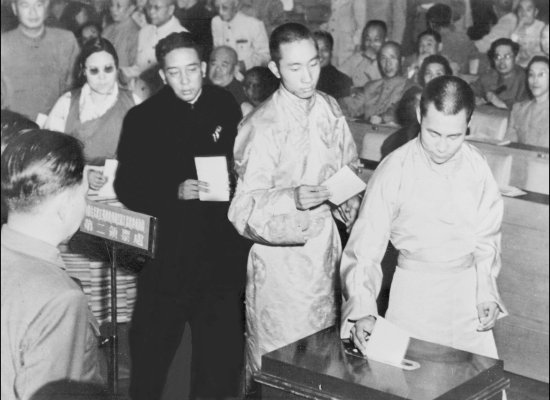
Dalai Lama
In this September 1954 picture, the two spiritual leaders of Tibet, the rival Panchen (C) and Dalai Lamas (R), both Tibet's MP, are shown casting their votes during the First Congress of the Chinese Communist Party in Beijing. Communist China announced 28 March 1959 that it had deposed the Dalai Lama and set up a new government in rebellious Tibet under the Panchen Lama. The late Panchen Lama (1938-89), a spiritual leader and teacher in Tibetan Buddhism (second in importance to the Dalai Lama), was said to be reincarnation of the Buddha Amitabha. He became the ward of the Chinese in his childhood, and some Tibetans disputed his status. Dalai Lama or Tenzin Gyatso, born in 1935, is the traditional religious and temporal head of Tibet's Buddhist clergy . In March 1959, there was an unsuccessful armed uprising by Tibetans against Chinese rule. As a result, the Dalai Lama, fled with some 100,000 supporters to northern India, where a government-in-exile was established. The Chinese ended the the former dominance of the lamas (Buddhist monks) and destroyed many monasteries. Tibet (Xizang), occupied in 1950 by Chinese Communist forces, became an 'Autonomous Region' of China in September 1965, but the majority of Tibetans have continued to regard the Dalai Lama as their 'god-king' and to resent the Chinese presence, leading to intermittent unrest. (Photo credit should read -/AFP/Getty Images)
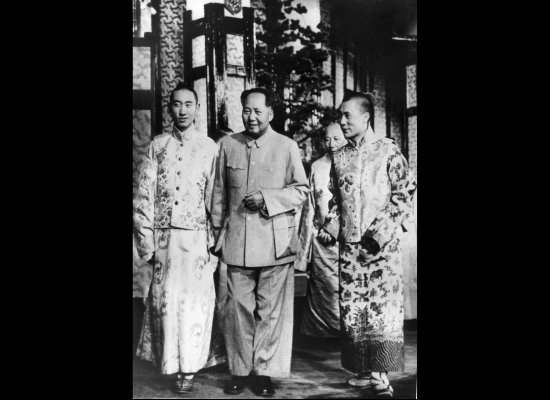
Dalai Lama
In this 1956 picture the two spiritual leaders of Tibet, the rival Panchen (L) and Dalai Lamas (R), are shown flanking their 'protector', Mao Zedong, Chairman of the People's Republic of China, in Beijing. Communist China announced 28 March 1959 that it had deposed the Dalai Lama and set up a new government in rebellious Tibet under the Panchen Lama. The late Panchen Lama (1938-89), a spiritual leader and teacher in Tibetan Buddhism (second in importance to the Dalai Lama), was said to be reincarnation of the Buddha Amitabha. He became the ward of the Chinese in his childhood, and some Tibetans disputed his status. Dalai Lama or Tenzin Gyatso, born in 1935, is the traditional religious and temporal head of Tibet's Buddhist clergy . In March 1959, there was an unsuccessful armed uprising by Tibetans against Chinese rule. As a result, the Dalai Lama, fled with some 100,000 supporters to northern India, where a government-in-exile was established. The Chinese ended the the former dominance of the lamas (Buddhist monks) and destroyed many monasteries. Tibet (Xizang), occupied in 1950 by Chinese Communist forces, became an 'Autonomous Region' of China in September 1965, but the majority of Tibetans have continued to regard the Dalai Lama as their 'god-king' and to resent the Chinese presence, leading to intermittent unrest. (Photo credit should read -/AFP/Getty Images)
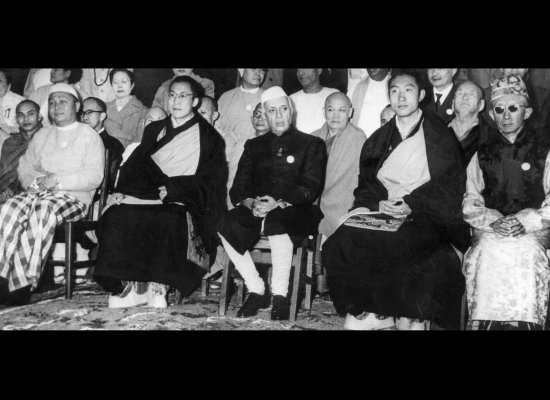
Dalai Lama
From left: Maharajah of Sikkim, Dalai Lama (or Tenzin Gyatso, born in 1935), traditional religious and temporal head of Tibet's Buddhist clergy, Jawaharlal Pandit Nehru, Indian Prime Minister, Panchem Ngoerhtehni Lama and U Nu, the former Prime Minister of Burma are seated 26 November 1956 in New Delhi during a Symposium on Buddhism's contribution to Art, Letters and Philosophy. (Photo credit should read -/AFP/Getty Images)

Dalai Lama With Indira Gandhi
The Dalai Lama of Tibet chats with India's Prime Minister Indira Gandhi during a visit to her New Delhi office 17 August 1966. He gave her a traditional gift of a silk scarf. It was the first meeting between the exiled spiritual leader of Tibet and the Prime Minister since she took office. (Photo credit should read STF/AFP/Getty Images)
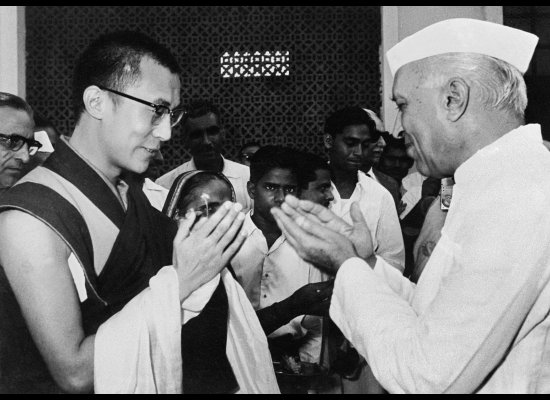
Dalai Lama With Indian Prime Minister Nehru
NEW DELHI, INDIA - JANUARY 1: Picture taken from the 60s of Indian prime minister Pandit Jawaharlal Nehru (R) and Dalan Lama in Buddhist salutation. Indian statesman and prime minister (1947-64) Nehru joined the Indian Congress Committee in 1918, he was influenced by Gandhi and was imprisoned several times by the British. In 1947 he became India's first prime minister and minister of external affairs. N/B B/W (Photo credit should read STAFF/AFP/Getty Images)
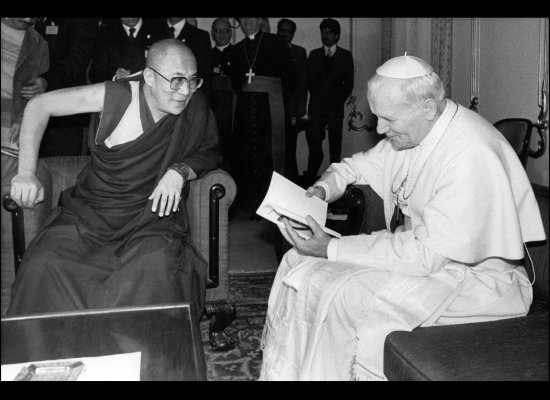
Dalai Lama With Pope John Paul II
Pope John Paul II in a picture taken 02 February 1986 in New Delhi checks a book entitled 'Opening The Eye Of New Awareness', the last book written by Dalai Lama (l), Spiritual Chief of Tibetan Budhists, during Pope's ten-day visit to India. AFP PHOTO (Photo credit should read VATICAN POOL/AFP/Getty Images)
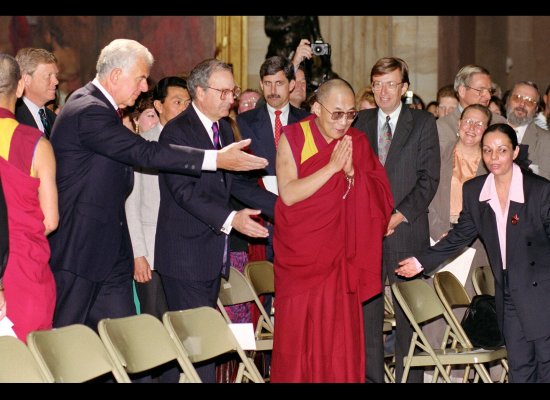
Dalai Lama At The U.S. Capitol
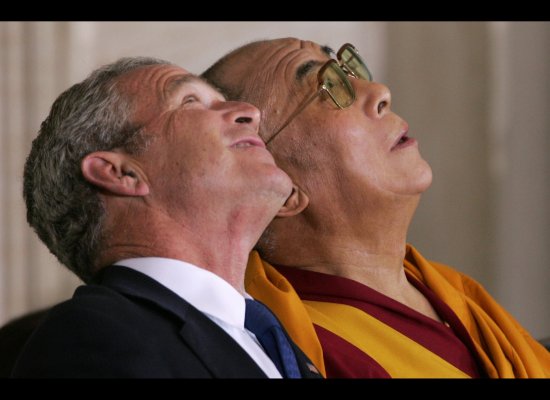
WASHINGTON, DC - APRIL 18: The Dalai Lama (C) is ushered into the Rotunda of the US Capitol, 18 April 1991, by the Speaker of the House Tom Foley (L) and Senate Majority Leader George Mitchell (2ndL). The Dalai Lama addressed members of the US House of Representatives and Senate. (Photo credit should read JENNIFER LAW/AFP/Getty Images)
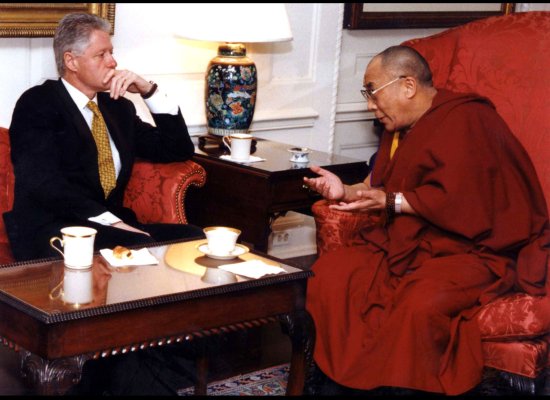
Dalai Lama With President Bill Clinton
US President Bill Clinton listens to Tibet's exiled spiritual lead, the Dalai Lama during a meeting November 10, 1998 at the White House in Washington, DC. The exiled spiritual leader said he was assured in the meeting with that U.S. officials would raise the status of Tibet with Chinese officials ``at every opportunity.'''' (photo by the White House)
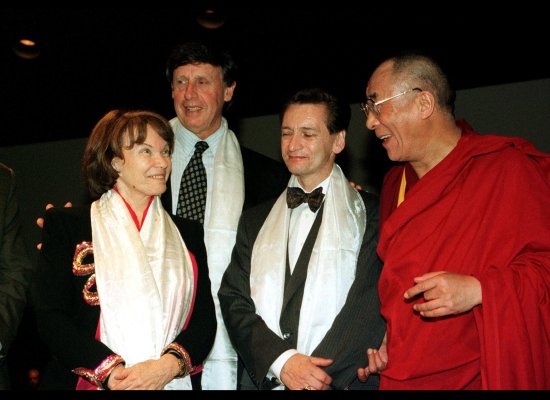
Dalai Lama
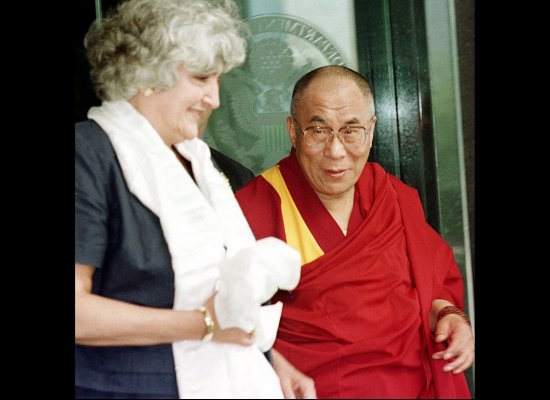
LOS ANGELES, UNITED STATES: The Dalai Lama(R) poses with Danielle Mitterrand(L), the former First Lady of France, Richard Blum(2nd L), a Californian Philanthropist, and Riki H. Chambers(2nd R), from the British House of Lords, after the three received awards the Light of Truth Award from the International Campaign for Tibet for their contributions to the public understanding of Tibet and its plight, in Los Angeles 11 October 1999. Chambers accepted the award on behalf of the former British envoy to Tibet, Hugh Richardson. AFP PHOTO Vince BUCCI (Photo credit should read Vince Bucci/AFP/Getty Images)
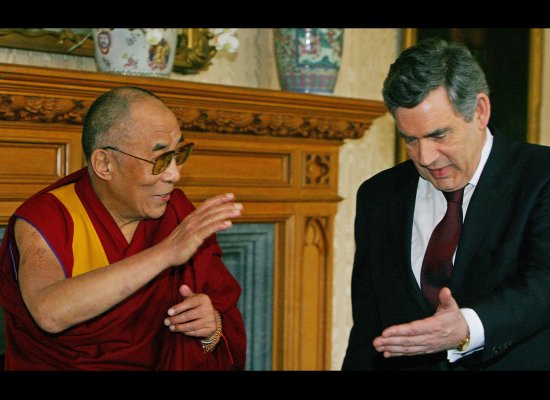
Dalai Lama With British Prime Minister Gordon Brown
The Dalai Lama (L) meets with British Prime Minister Gordon Brown at Lambeth Palace in London, on May 23, 2008. The Dalai Lama held closed-door talks Friday with British Prime Minister Gordon Brown, who has faced a diplomatic balancing act between backing Tibetan rights while not offending Beijing. The meeting -- held not in Brown's Downing Street office, but at a clerical residence nearby -- was the most contentious part of an 11-day visit to Britain by the Tibetan spiritual leader, who is on a five-nation tour. AFP PHOTO/CARL DE SOUZA/WPA POOL/AFP (Photo credit should read CARL DE SOUZA/AFP/Getty Images)
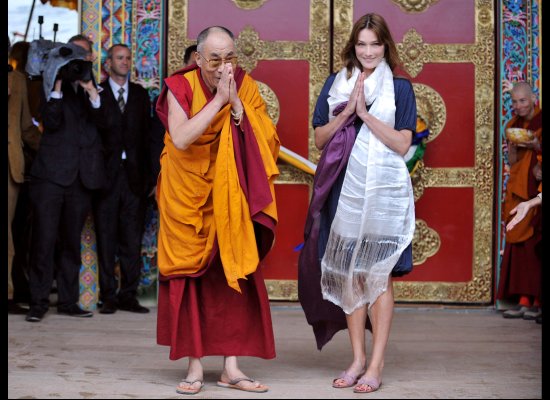
Dalai Lama With Carla Bruni-Sarkozy
Tibetan spiritual leader Dalai Lama (L) and France's first lady Carla Bruni-Sarkozy (R) attend the inauguration of the Buddhist Lerab Ling temple in Roqueredonde, southern France on August 22, 2008. Planned more than two years ago, the Dalai Lama's 12-day French visit turned political after a Chinese crackdown on unrest in Tibet in March that sparked international outrage. President Nicolas Sarkozy declined to meet the Dalai Lama, sparking accusations from the opposition Socialists that 'the only guiding principle (of Sarkozy's policy towards China) appears to be not to displease Beijing.' AFP PHOTO POOL PASCAL GUYOT (Photo credit should read PASCAL GUYOT/AFP/Getty Images)
The Chinese government probably had an idea about the Dalai Lama's big Thursday
announcement. Speaking to reporters in Beijing on Monday, Padma Choling, the Chinese-appointed governor of Tibet, said the exiled leader did not have a right to choose his successor the way he wanted. "We must respect the historical institutions and religious rituals of Tibetan Buddhism," he said. "It is not up to anyone whether to abolish the reincarnation institution or not."
The Chinese government, which claims it has to approve all reincarnations of living Buddhas, or reincarnated lamas of Tibetan Buddhism, has been nervous since 2007, when the Dalai Lama told a Japanese newspaper that he might select his successor in his lifetime. Since then, there has been endless speculation on the multiple ways the incarnation of the Dalai Lama could be selected. In the past few years, the 14th Dalai Lama has spoken about three ways in which he can alter the succession process of his lineage: First, he can abolish the institution of the Dalai Lamas; Second, he can hand-pick his successor in his lifetime; and third, the Tibetans can elect the next leader through democratic elections.
Choosing the Dalai Lama has never been easy. Now, with China saying it has to sign off on the choosing of the next Dalai Lama, it seems a new battle of nerves between the Dalai Lama and Beijing is about to begin. "It's China's wishful thinking that if the Dalai Lama disappears from the scene, it would resolve the issue of Tibet," says Samdhong Rinpoche, prime minister of the Tibetan government in exile.
In fact, Dharamshala began to work on a post-Dalai Lama plan in 1995 when a six-year-old boy chosen as the 11th Panchen Lama, who would play the most important role in the selection of the Dalai Lama's next reincarnation, vanished. In his place, the Chinese planted the son of aCommunist party official as the 11th Panchen Lama.
The Dalai Lama's decision to hand over his political powers to the head of the Tibetan government-in-exile may be a way of getting out of the Panchen dilemma. "With the Panchen Lama in Chinese hands and the Karmapa not ready to assume leadership, the Dalai Lama has gone for the third option of selecting the next leader through elections," says a member of the Kashag (cabinet).
The Chinese government, which claims it has to approve all reincarnations of living Buddhas, or reincarnated lamas of Tibetan Buddhism, has been nervous since 2007, when the Dalai Lama told a Japanese newspaper that he might select his successor in his lifetime. Since then, there has been endless speculation on the multiple ways the incarnation of the Dalai Lama could be selected. In the past few years, the 14th Dalai Lama has spoken about three ways in which he can alter the succession process of his lineage: First, he can abolish the institution of the Dalai Lamas; Second, he can hand-pick his successor in his lifetime; and third, the Tibetans can elect the next leader through democratic elections.
Choosing the Dalai Lama has never been easy. Now, with China saying it has to sign off on the choosing of the next Dalai Lama, it seems a new battle of nerves between the Dalai Lama and Beijing is about to begin. "It's China's wishful thinking that if the Dalai Lama disappears from the scene, it would resolve the issue of Tibet," says Samdhong Rinpoche, prime minister of the Tibetan government in exile.
In fact, Dharamshala began to work on a post-Dalai Lama plan in 1995 when a six-year-old boy chosen as the 11th Panchen Lama, who would play the most important role in the selection of the Dalai Lama's next reincarnation, vanished. In his place, the Chinese planted the son of aCommunist party official as the 11th Panchen Lama.
The Dalai Lama's decision to hand over his political powers to the head of the Tibetan government-in-exile may be a way of getting out of the Panchen dilemma. "With the Panchen Lama in Chinese hands and the Karmapa not ready to assume leadership, the Dalai Lama has gone for the third option of selecting the next leader through elections," says a member of the Kashag (cabinet).
It seems the 14th Dalai Lama is stepping out of his political role.
The exiled spiritual leader of Tibet has also been the political leader of the region since his reign began in 1950. However, he has lived in exile for almost 52 years, since a 1959 uprising forced him to flee to India.
Since then, his Eminence the Dalai Lama has advocated for a number possible solutions for the region, including turning it into a "zone of peace," free of nuclear weapons and with support for human rights. He has campaigned for numerous peaceful solutions throughout the years, meeting with world leaders to discuss important human rights issues.
However, the Lama has long sought to divorce himself from the political struggles of Tibet, as he feels his image looms over the situation. According to the AP, he plans to propose amendments to the exile constitution "reflecting my decision to devolve my formal authority to the elected leader."
For some historic images of the Dalai Lama's long political career, check out the images below.

No comments:
Post a Comment